Bathroom and Kitchen Mold Removal: Huntsville Homeowner's Guide
Bathrooms and kitchens are the two rooms in your Huntsville home most likely to develop mold problems, and for good reason. Both spaces combine moisture, organic materials, limited airflow, and temperature fluctuations that create exactly the conditions mold needs to thrive. Whether you're dealing with black spots between tile grout, fuzzy growth on drywall behind the toilet, or a musty smell coming from under your kitchen sink, understanding what you're working with and how to address it properly can save you from a much larger remediation job down the road.
Why Huntsville Homes Are Especially Vulnerable in These Rooms
Huntsville sits in a climate zone where humidity is a persistent challenge. Summers regularly push outdoor relative humidity above 80 percent, and that moisture finds its way indoors constantly. When your bathroom exhaust fan is undersized, slow, or simply not used long enough after a shower, the steam from that 10-minute hot shower lingers in the room for 30 minutes or more. Over weeks and months, that residual humidity penetrates grout, wallboard paper, and cabinet interiors, creating a slow-building mold environment that can go undetected for a long time.
Kitchens face a different but equally persistent moisture problem. Cooking generates steam, dishwashers produce heat and humidity during cycles, and the area under the sink is prone to slow drips from supply lines and drain connections. If that under-sink space also has a garbage disposal with condensation, you may have a consistently damp environment that rarely fully dries out. In older Huntsville homes with original cabinetry and no moisture barriers behind the sink base, this can lead to mold that penetrates into the cabinet flooring and even the subfloor beneath it.
Identifying the Scope Before You Start Removal
Before reaching for bleach and a scrub brush, take time to actually assess the scope of what you're dealing with. Surface mold and systemic mold require completely different approaches, and treating a systemic problem with a surface cleaning method will guarantee it returns.
Surface mold appears on the outermost layer of a material and has not penetrated into the substrate. This is common on tile faces, the inside of shower curtains, the surface of grout before deterioration, and the interior walls of cabinets. Surface mold can often be addressed with appropriate cleaning agents if you act early and the material underneath is non-porous and intact.
Penetrating mold has worked its way into porous materials including drywall, grout, wood cabinetry, and caulk. Once mold penetrates drywall or wood, surface cleaning does not solve the problem. Those materials need to be removed and replaced. A common mistake Huntsville homeowners make is cleaning the surface of moldy drywall, painting over it, and considering the issue resolved. The mold inside the wallboard continues to grow and typically reappears through fresh paint within months.
The test is simple: if the material is soft, discolored deeper than the surface, or if you press gently and the surface feels soft or spongy, the mold has penetrated and the material needs to go. If the mold wipes away from a hard, intact surface and the material underneath shows no staining or soft spots, you may be dealing with surface growth only.
Tile and Grout Mold in Huntsville Bathrooms
Grout is porous. Even properly sealed grout absorbs moisture over time, and once the sealer degrades, which happens on a timeline of one to three years in a regularly used shower, the grout becomes a prime mold habitat. Black and dark green mold in grout lines is extremely common in Huntsville showers, and the approach depends on how far it has progressed.
For early-stage grout mold, an oxygen bleach solution applied with a stiff grout brush and allowed to dwell for 10 to 15 minutes before scrubbing is often effective. Oxygen bleach is preferable to chlorine bleach in enclosed spaces because the fumes are less harsh and it is safer to use near grout sealers. After scrubbing and rinsing thoroughly, allow the area to dry completely before applying a fresh grout sealer.
When grout mold has progressed to the point where the grout itself is crumbling, darkened throughout its depth, or where you can see staining extending to the tile substrate behind it, regrouting is the correct solution. This involves removing the deteriorated grout with an oscillating tool or grout saw, cleaning the joints thoroughly, allowing the area to dry, and applying fresh grout followed by sealer once cured. If the tile substrate or backer board behind the tiles shows mold growth or water damage, that adds another layer of complexity requiring the tile to come down for inspection and repair.
Caulk at the base of the shower, around the tub surround, and where the shower wall meets fixtures is also a critical mold location. Caulk is silicone or acrylic-based and is not a cleanable surface once mold penetrates it. When you see black staining inside or behind shower caulk, the right approach is to remove the caulk entirely, clean the joint, allow it to dry, and apply fresh mold-resistant caulk. This is a straightforward job that homeowners can do themselves with patience and the right tools.
Drywall and Cabinetry Mold in Bathrooms and Kitchens
Drywall behind toilets, under vanity sinks, and adjacent to showers is a common mold location in Huntsville homes because these areas accumulate moisture and are rarely inspected. A slow toilet supply line leak, condensation on a cold porcelain base, or splash moisture that works under a vanity can saturate drywall repeatedly over months before the mold becomes visible on the surface.
When drywall needs to be removed for mold remediation, the process involves cutting out the affected section with a minimum of 12 inches of clearance beyond any visible mold growth, treating the framing and surrounding surfaces with an antimicrobial solution, allowing the area to dry completely before reconstruction, and replacing with moisture-resistant drywall, sometimes called green board or cement board in high-moisture areas. Standard drywall should not be used in areas within direct splash zones or behind shower tiles.
Kitchen cabinetry under the sink is often made from particleboard with a laminate face. This material is extremely susceptible to water damage and mold. Once particleboard gets wet and swells, it does not return to its original state, and mold inside swollen particleboard cannot be effectively cleaned. Replacement of the affected cabinet components is typically the only practical solution. While the cabinet is open, inspect the subfloor beneath for any soft spots, dark staining, or mold growth, as a long-running sink leak can cause subfloor damage that needs addressing before the cabinet is reinstalled.
Ventilation: The Root Cause Most Homeowners Overlook
If you remove mold from your bathroom or kitchen and do not address ventilation, the mold will return. This is the single most common reason mold recurs after cleaning in Huntsville homes.
Bathroom exhaust fans are rated by cubic feet per minute, or CFM. The general guideline is 1 CFM per square foot of bathroom floor area, with a minimum of 50 CFM for small bathrooms. However, many older Huntsville homes have fans installed decades ago that are undersized, partially clogged with dust, or exhausted into the attic rather than to the exterior. A fan exhausting into the attic does not remove moisture from the house — it moves moisture from the bathroom into the attic, which creates a secondary mold problem in a much harder-to-access space.
When evaluating your bathroom fan, check whether the duct runs to an actual exterior vent cap and not just into the attic space. Check that the fan operates without excessive noise, which can indicate a worn motor or obstruction. Clean the fan cover and check the blades for dust buildup, which significantly reduces airflow. If the fan is more than 10 years old or noticeably loud, replacement is often the most cost-effective solution. Modern fans are substantially quieter, more energy-efficient, and more effective than older models.
Kitchen range hoods serve a similar moisture removal function for cooking steam. Recirculating range hoods that do not vent to the exterior only filter grease and odors; they do not remove humidity. If your range hood recirculates, it is not helping with mold prevention. Converting to an exterior-vented hood where possible is a meaningful upgrade for kitchens prone to moisture problems.
Common Mistakes That Make Bathroom and Kitchen Mold Worse
Painting over mold is perhaps the most common mistake. Mold-resistant paint does not kill existing mold. It may slow regrowth on the surface, but it traps active mold colonies inside the wall where they continue to spread.
Using bleach on porous materials is another frequent error. Chlorine bleach is effective at removing the surface color of mold on non-porous materials like tile and tub surrounds, but it does not penetrate into porous surfaces like drywall, grout, or wood. The bleach kills the surface cells, but the root structures of the mold colony inside the material remain intact and regrow. This is why bleach appears to work initially but the mold returns in the same location.
Ignoring the moisture source is the third critical mistake. Mold is a symptom of a moisture problem. Cleaning the mold without finding and fixing the source — whether that's a dripping supply line, a failing shower pan, a clogged drain, or inadequate ventilation — guarantees recurrence.
When to Call a Professional for Kitchen and Bathroom Mold
There are situations where professional assessment and remediation are the appropriate choice rather than a DIY project. If mold covers an area larger than 10 square feet in a single room, professional remediation is recommended by EPA guidelines. If you have opened a wall and found mold extending significantly behind the visible surface, if household members are experiencing respiratory symptoms, or if you have previously attempted cleaning and the mold has returned in the same location, these are all indicators that the situation warrants professional evaluation.
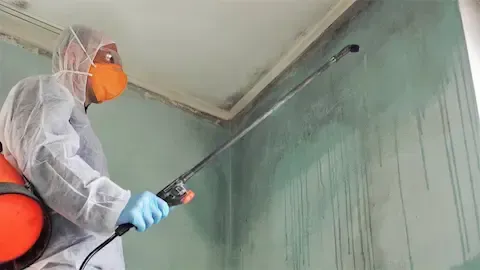
Professional mold remediation in Huntsville bathrooms and kitchens involves containment of the work area, air filtration during removal, safe disposal of contaminated materials, treatment of structural surfaces, and post-remediation verification. This systematic approach addresses both the visible mold and the spores that become airborne during removal, which is difficult to manage effectively without professional equipment.
If you're dealing with recurring bathroom mold that keeps coming back despite your best efforts, a professional assessment can identify the underlying moisture pathway that you may be missing. Often the source is less obvious than a visible drip — it may be a hairline crack in a shower pan, a condensation problem on a cold-water pipe, or a construction detail that allows exterior moisture to enter behind tile.
Preventing Recurrence After Mold Removal
Successful mold prevention in Huntsville bathrooms and kitchens comes down to three consistent habits: control moisture at the source, improve airflow, and inspect regularly.
Run bathroom exhaust fans for at least 20 to 30 minutes after every shower, not just during it. Consider an occupancy or humidity sensor switch that automatically runs the fan until relative humidity in the room drops to an appropriate level. Wipe down shower walls and glass after each use to remove the standing water that feeds surface mold growth. Keep caulk and grout in good condition, resealing grout annually and replacing caulk whenever you see staining or separation.
Under the kitchen sink, install a small moisture alarm that will alert you to drips before they have a chance to soak into cabinet materials. Check supply lines and drain connections every few months. Keep the cabinet door open periodically to allow air circulation if the interior tends to stay humid.
Inspect both spaces seasonally — pull back the toilet, look under the vanity, check the base of the shower walls, and look inside cabinets. Catching mold early, when it is still surface growth on a cleanable material, is dramatically easier and less expensive than addressing a system that has had months or years to develop.
For homeowners in the Huntsville area dealing with persistent moisture problems in bathrooms or kitchens, understanding the difference between surface treatment and true remediation is the starting point for a lasting solution. Most mold problems in these rooms are correctable when addressed at the right level — but that requires an honest assessment of what you're dealing with before deciding on an approach. Whether you handle it yourself or bring in professional help, addressing both the mold and its moisture source is the only way to achieve a durable result.
