Why Huntsville Homes Built Before 1995 Have Crawl Space Mold Issues
If your Huntsville home was built before 1995, the odds are higher than you might expect that something problematic is happening beneath your floors right now. A generation of residential construction across Madison County relied on building practices that, while standard at the time, consistently produce crawl space mold problems as homes age. This is not a matter of poor workmanship or bad luck. It is a matter of design conventions that were common across the industry during that era and that interact badly with North Alabama's warm, humid climate over the long term.
What Made Pre-1995 Huntsville Construction Different
Homes built in Huntsville's older neighborhoods during the 1970s, 1980s, and early 1990s share a handful of structural characteristics that consistently show up in crawl space mold cases. Understanding these characteristics helps you recognize whether your home is at elevated risk.
The most significant factor is the vapor barrier standard in use during that period. Homes built before 1995 typically used thin polyethylene sheeting, often 4 to 6 mil thickness, laid loosely across the crawl space floor. This sheeting was not sealed at the seams or around the perimeter, and it was not attached to the foundation walls. Over time, the sheets shift, tear, and separate, leaving large portions of bare soil exposed. Bare soil in a crawl space continuously releases ground moisture into the enclosed air space beneath your home.
Ventilation strategy was also different. The dominant assumption in residential construction before the mid-1990s was that crawl spaces should be vented to the outside to allow moisture to escape. Huntsville's climate made this approach particularly ineffective. During summer months, outdoor air entering the crawl space is hot and humid. When that air contacts the cooler surfaces beneath the floor structure, including wood joists, subfloor sheathing, and ductwork, condensation forms. The result is a consistently damp environment that creates ideal conditions for mold colonization.
Specific Neighborhoods and Development Patterns at Risk
Huntsville's residential development through the postwar decades followed distinct geographic patterns that track closely with crawl space risk. Neighborhoods developed in the 1960s and 1970s in areas like Blossomwood, Five Points, and sections of south Huntsville contain some of the oldest housing stock in the city. These homes have had decades for original vapor barriers to degrade and for wood in the crawl space to go through repeated moisture cycles.
The significant development boom that accompanied NASA and defense contractor growth through the 1980s and into the early 1990s pushed construction further into Madison County, including areas around Madison city limits and the Research Park corridor. Homes built during this period are now reaching the age at which original vapor barrier materials are failing in meaningful numbers. Many homeowners in these areas are encountering crawl space mold problems for the first time, unaware that the construction standard their home was built to sets up this outcome.
Older sections of the Meridianville and Toney communities, where residential development expanded during the same era, show similar patterns. The common thread is not geography but construction vintage.
How Aging Vapor Barriers Create Cascading Problems
The failure mode of older vapor barriers is rarely dramatic. It happens gradually, and most homeowners do not notice it until mold is already established. A typical progression looks like this.
The original polyethylene sheeting begins to degrade from UV exposure during any period when the crawl space access was open, from foot traffic during maintenance visits, and from the simple brittleness that develops in plastic sheeting after fifteen to twenty years. Seams that were never sealed begin to separate. Areas where the sheeting was cut around piers or utility penetrations open wider. Over a period of years, what was once nominal vapor control becomes largely ineffective.
As ground moisture enters the crawl space air more freely, wood components absorb that moisture. Wood joists, rim boards, and subfloor sheathing that maintain moisture content above 19 percent for extended periods become susceptible to mold colonization. Common species found in these environments include Cladosporium, Penicillium, and Aspergillus, all of which thrive in the moderate temperatures and elevated humidity typical of a North Alabama crawl space in summer.
Ductwork running through the crawl space compounds the problem. In many pre-1995 Huntsville homes, HVAC ductwork passes through the unconditioned crawl space. The cool surface of supply ducts becomes a condensation point, and mold can establish on duct insulation surfaces as well as on adjacent wood framing.
Signs That Your Older Huntsville Home Has a Problem
Several indicators suggest that a pre-1995 home may already have mold activity in the crawl space, even if you have never looked beneath the floor.
Musty odor in the home that is more pronounced on lower floors or first thing in the morning when the house has been closed overnight
Soft spots or slight flexing in flooring over areas of the crawl space, which can indicate wood deterioration
Higher-than-expected humidity on the first floor, particularly during summer months even when air conditioning is running
Increased allergy or respiratory symptoms among household members, which can correlate with elevated airborne mold spore counts indoors
Visible deterioration of the vapor barrier if you have looked into the crawl space recently
None of these signs is definitive on its own, but any combination should prompt a proper inspection. For a thorough look at what professional assessment and remediation involve, the complete crawl space mold remediation guide covers the process in detail.
Why Partial Repairs Often Fail in These Homes
A predictable pattern emerges when older Huntsville homes with crawl space mold receive incomplete remediation. A contractor cleans visible mold from the wood surfaces, removes the failed vapor barrier, and installs a new layer of standard polyethylene sheeting. Within two to three years, mold returns. Sometimes faster.
The reason is that the root cause, which is the ventilated crawl space design, was never addressed. As long as warm, humid outdoor air continues to enter the crawl space through foundation vents, condensation will continue to form on cool surfaces. Mold is opportunistic. Even trace amounts of remaining spores in the wood, combined with ongoing moisture, are sufficient for recolonization.
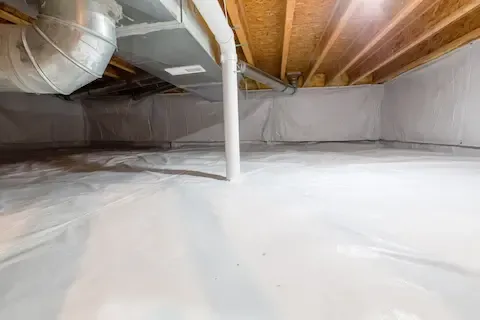
Effective remediation for pre-1995 homes almost always requires encapsulation rather than replacement of a thin vapor barrier. Encapsulation involves sealing the crawl space from the outside environment, installing a heavy-duty continuous liner across the floor and up the foundation walls, sealing all penetrations, and converting the crawl space to a conditioned or semi-conditioned environment. This eliminates the condensation cycle that drives mold growth in these older construction types.
The Cost Equation for Older Huntsville Homes
Homeowners in Huntsville's established neighborhoods sometimes weigh the cost of encapsulation against what seems like an uncertain benefit. The calculation shifts when you account for what ongoing moisture damage costs over time. Wood deterioration in floor joists that progresses without correction leads to structural repair costs that can exceed encapsulation several times over. Real estate transactions increasingly involve crawl space inspections, and discovered mold or wood damage in a Huntsville home can complicate closing or reduce sale price more than remediation would have cost.
For homes in the pre-1995 construction window, the question is less often whether encapsulation is the right solution and more often when to address it. The crawl space encapsulation process, done correctly, converts a chronically problematic space into one that remains stable across seasons and years.
What to Expect When You Have an Older Home Assessed
A proper assessment of a pre-1995 Huntsville crawl space involves more than a visual check through the access hatch. A thorough inspection documents the condition of the vapor barrier, measures moisture content in the wood framing, checks for visible mold colonization on all accessible surfaces, and assesses the current ventilation configuration and ductwork condition.
This baseline matters because it determines what remediation scope is actually necessary. Homes where mold colonization is limited to surface growth on wood framing require a different approach than homes where structural wood has been absorbing moisture long enough for deeper damage to develop. In either case, understanding the full picture before remediation begins produces better outcomes and avoids the partial-repair pattern that leads to repeat problems.
If your Huntsville home was built before 1995 and you have never had the crawl space professionally assessed, that assessment is the logical first step. The construction patterns that put these homes at risk were universal, not exceptions, and the mold problems they produce are predictable enough that they warrant proactive attention rather than waiting for obvious symptoms to appear.
