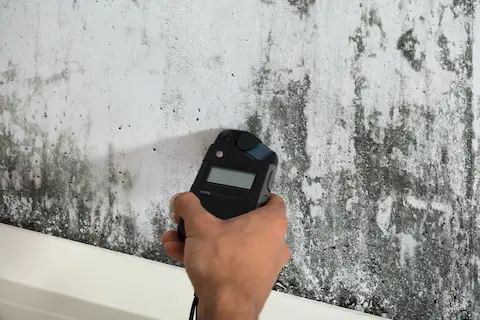
Clearance Testing After Mold Removal: A Huntsville Guide
When a remediation crew tells you the job is done, that statement alone should not be enough. Mold removal in Huntsville homes involves more than wiping surfaces and bagging debris. Clearance testing is the structured, documented process that confirms the work actually met professional standards before you sign off and release final payment. Without it, you are relying entirely on the word of the company that performed the work — a clear conflict of interest that leaves you exposed if mold returns.
What Clearance Testing Actually Measures
Clearance testing — also called post-remediation verification — evaluates whether a treated area has returned to normal, acceptable conditions after mold removal. It is not a simple visual check. Instead, it involves air sampling, surface sampling, and sometimes moisture readings to compare the remediated space against baseline conditions in unaffected areas of the same structure.
Specifically, clearance testing looks at three things:
- Airborne spore counts — The concentration of mold spores in the treated area should not be significantly elevated compared to outdoor air or unaffected interior areas.
- Surface contamination — Swab or tape lift samples from remediated surfaces confirm that visible and invisible mold growth has been eliminated.
- Moisture levels — Because mold cannot survive without adequate moisture, post-remediation readings verify that the underlying moisture problem has been corrected. If moisture is still present, new mold growth is only a matter of time.
Huntsville's climate complicates this. High humidity during spring and summer months in the Tennessee Valley means that ambient moisture conditions are already elevated compared to drier regions. A competent tester accounts for seasonal baseline conditions when interpreting results, which is another reason local expertise matters.
Why Third-Party Testing Is the Only Acceptable Standard
The single most important principle in clearance testing is independence. The company that performed your mold remediation should never be the same company that conducts the clearance test. This is not just a best practice — it is a structural safeguard that protects you from a straightforward conflict of interest.
When a remediation contractor tests their own work, they have a financial incentive to declare the job complete. Even without deliberate dishonesty, confirmation bias can influence how samples are collected, where they are placed, and how results are interpreted. A third-party industrial hygienist or certified mold inspector has no stake in whether the remediation passed or failed. Their job is simply to report what the data shows.
In Huntsville, as in most of Alabama, there is no state licensing requirement that mandates third-party clearance testing — which means some contractors will skip it entirely unless you require it. Before any remediation work begins, confirm in writing that clearance testing will be conducted by an independent party. If a contractor resists or discourages you from requiring independent verification, treat that as a significant warning sign. Post-Remediation Verification done properly should always be welcomed by a contractor who is confident in their work.
Post-Remediation Testing Standards You Should Know
Several professional standards govern how post-remediation testing should be conducted. Reputable inspectors in the Huntsville area typically follow guidelines established by the American Industrial Hygiene Association (AIHA), the Institute of Inspection, Cleaning and Restoration Certification (IICRC S520 standard), or the New York City Department of Health mold guidelines, which have become a widely referenced benchmark even outside New York.
Under these standards, a clearance inspection generally requires:
- A visual inspection of the remediated containment area to confirm that physical cleanup is complete, containment materials have been properly removed, and there is no visible mold or debris remaining.
- Air sampling inside the remediated area and in at least one control location (typically outdoors or in an unaffected room) using calibrated equipment and cassettes analyzed by an accredited laboratory.
- Surface sampling when visual inspection identifies questionable areas or when the remediation involved porous materials like wood framing.
- Written documentation of all sample locations, collection methods, chain of custody for lab samples, and laboratory results.
Results are not always black and white. A qualified inspector interprets the data in context — comparing indoor and outdoor spore counts, accounting for seasonal conditions in North Alabama, and noting whether specific mold species present any elevated concern. Stachybotrys or Chaetomium detected post-remediation, for example, carries different implications than a minor elevation in Cladosporium, which is common outdoors throughout Madison County.
The Documentation You Should Receive Before Final Payment
Clearance testing is only useful if it produces documentation you can actually review, retain, and reference. Before releasing your final payment to a remediation contractor, you should have the following in hand:
- A written clearance report from the third-party inspector, signed and dated, stating whether the remediated area passed or failed clearance standards.
- Laboratory analysis reports showing the raw spore count data for each sample collected, including indoor and control samples, with the accredited lab's name and chain-of-custody documentation.
- A moisture reading log showing post-remediation readings in the affected area compared to target thresholds (typically below 16 percent moisture content in wood materials).
- Photographs taken during the clearance inspection documenting conditions at the time of testing.
- Remediation scope documentation from the contractor confirming what work was performed, what materials were removed, and how the containment was managed.
This documentation set matters beyond your personal record-keeping. If you ever sell your home in Huntsville, buyers and their inspectors will likely inquire about any history of mold remediation. A complete documentation file demonstrates that the problem was handled professionally and verified independently — a meaningful distinction from undocumented work.
When Clearance Testing Fails
Failed clearance is not uncommon, and it is not a catastrophe. It is information. If air samples show elevated spore counts after remediation, it means either that the physical removal was incomplete, containment was breached during cleanup, or there is an additional mold source that was not identified in the original scope.
A reputable remediation contractor will respond to a failed clearance by returning to address the deficiency at no additional charge. This should be specified in your remediation contract before work begins — sometimes called a re-remediation clause. If a contractor is unwilling to commit to this standard in writing, that is a concern worth taking seriously before you authorize any work.
For homeowners in areas like Hampton Cove, Twickenham, or the older neighborhoods near downtown Huntsville where aging construction increases remediation complexity, the chances of a first-pass failure are meaningfully higher. Older homes have more irregular framing, hidden cavities, and original materials that can complicate thorough removal.
Making Clearance Testing Part of Your Remediation Agreement
The cleanest approach is to address clearance testing before a single square foot of work begins. Include a written requirement in your remediation contract stating that third-party clearance testing will be required before final payment is released. Identify in advance who will perform the testing — ideally an industrial hygienist or certified inspector with no business relationship with the remediation company.
For context on what a complete verification process looks like from start to finish, the post-remediation verification guide for Huntsville covers the full scope of what proper verification involves, including how pre-remediation testing feeds into post-remediation comparison.
Huntsville homeowners who treat clearance testing as a contractual requirement rather than an optional add-on are consistently better protected. The testing itself is a relatively modest cost compared to the total remediation investment, and it provides a level of documented assurance that no contractor guarantee alone can match.
