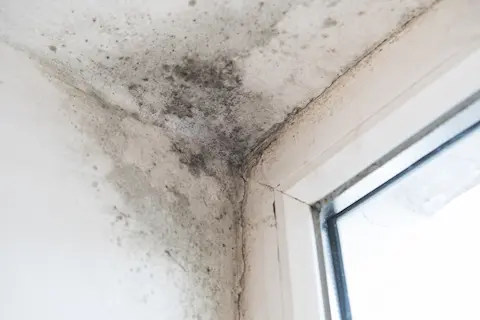
Wall Cavity Mold: Why Huntsville Homes Hide It and How We Find It
Huntsville homes are built to manage heat, humidity, and seasonal temperature swings — but that same construction logic creates conditions where mold can establish itself inside wall cavities and go completely undetected for months. You might notice a faint musty odor near a baseboard, see paint bubbling near a window frame, or feel an unusual chill in one section of wall. These are not cosmetic issues. They are surface signals of a problem that has likely been developing in the dark, behind your drywall, for far longer than you realize.
Why Huntsville's Climate Drives Wall Cavity Mold
North Alabama sits in a humid subtropical climate zone. Summers bring prolonged heat and high outdoor humidity, while winters introduce cold snaps that cool wall cavities rapidly. That temperature differential — warm interior air meeting a cooler wall surface or vapor barrier — creates the condensation conditions that mold spores need to germinate. When you add in the common practice of running air conditioning aggressively through spring and summer, interior surfaces near exterior walls cycle through wet and dry phases repeatedly.
Homes in older Madison County neighborhoods often lack vapor barriers installed to current standards, and many 1970s through 1990s builds used paper-faced insulation batts that absorb moisture readily. Modern construction is not immune either. Tight building envelopes trap moisture that might otherwise escape, particularly when HVAC systems are undersized or when ventilation is uneven across rooms.
What Wall Cavity Mold Actually Looks Like Before You Open the Wall
The challenge with cavity mold is that you rarely see it directly. What you see are secondary symptoms, and those symptoms are easy to misread. Here is what to watch for in a Huntsville home:
- Discoloration at baseboard seams — a gray or greenish stain that returns after cleaning
- Drywall that feels soft or slightly spongy when pressed near the floor or around window rough openings
- Paint that bubbles, peels, or separates from the wall surface without clear cause
- A persistent musty smell that intensifies when the HVAC kicks on or when exterior humidity rises
- Allergy-like symptoms — nasal congestion, itchy eyes, coughing — that improve when occupants leave the building
None of these signs confirm cavity mold on their own. But when two or more appear together, especially near exterior walls or plumbing runs, you have enough reason to investigate further.
Detection Methods Used by Remediation Professionals
Identifying wall cavity mold without unnecessary demolition requires a layered approach. A trained remediation professional working in the Huntsville area will typically use the following tools in combination:
Moisture meters read the moisture content of drywall surfaces without penetration. Readings above 16 percent in a finished wall signal conditions favorable to mold growth. Readings above 20 percent suggest active moisture intrusion and near-certain microbial activity.
Thermal imaging cameras detect temperature differentials in wall surfaces. A cold spot on an interior wall in summer often indicates evaporative cooling from moisture — a reliable indicator of wet insulation or accumulated condensation behind the drywall. Thermal imaging does not confirm mold directly, but it maps areas worth investigating further.
Bore scope cameras allow visual inspection through a small drilled hole, typically 3/4 inch in diameter. The scope lights the cavity and captures video or still images of the insulation, framing, and drywall back face. This method provides direct visual confirmation before any significant demolition begins.
Air sampling can detect elevated spore counts in room air or directly within a wall cavity using a surface cassette pressed against an opened penetration. If interior spore counts significantly exceed outdoor baseline counts for the same species, that differential confirms active colonization somewhere in the building envelope.
The Demolition Protocol When Mold Is Confirmed
Confirming cavity mold means the remediation work must follow a protocol designed to prevent cross-contamination to unaffected areas of the home. This is where working with experienced Residential Mold removal professionals becomes critical — improper demolition can aerosolize millions of spores into living areas that were previously clean.
Standard protocol for Huntsville homes typically includes:
- Containment setup — plastic sheeting isolates the work zone, and negative air pressure is established using HEPA-filtered air scrubbers exhausted to the exterior
- PPE compliance — workers wear full respirators and disposable suits to prevent cross-contamination between the work zone and unaffected areas
- Controlled drywall removal — affected panels are scored and removed in sections, bagged in heavy plastic before removal from the work area
- Structural assessment — wood framing is inspected for surface mold, staining, and structural compromise; minor surface mold on sound framing can often be addressed with HEPA vacuuming and an EPA-registered antimicrobial treatment
- Insulation removal and disposal — contaminated insulation batts are bagged and disposed of; insulation cannot be cleaned and must be replaced
- Post-remediation verification — clearance air sampling is conducted before containment is dismantled to confirm spore counts have returned to acceptable levels
What the Rebuild Requires to Prevent Recurrence
Opening a wall is an opportunity. Closing it back up incorrectly means you are likely to face the same problem again within two to five years. For Huntsville homes specifically, the rebuild phase should address the conditions that allowed moisture to accumulate in the first place.
Vapor barrier placement matters. In a mixed-humid climate like North Alabama, vapor barriers are most effective when placed toward the exterior in winter and toward the interior in summer — a genuinely conflicting set of requirements that most single-layer vapor barriers cannot satisfy. Modern closed-cell spray foam applied to the cavity-side face of exterior sheathing solves this problem by acting as both insulation and vapor retarder.
Window and door rough openings must be properly flashed and sealed. A large percentage of wall cavity mold cases in Huntsville originate at window rough openings where bulk water has been infiltrating during rain events, often for years before symptoms surface at the interior.
Drainage planes matter too. If the original construction lacked a proper weather-resistant barrier between exterior cladding and sheathing, that deficiency should be corrected during rebuild, even if it means pulling exterior cladding on the affected wall section.
When One Wall Suggests a Larger Problem
Wall cavity mold found in one location does not always stay in one location. Mold travels through HVAC ductwork, through shared wall assemblies, and via air movement through unsealed penetrations. A single confirmed cavity in a bedroom near a Huntsville home's northwest corner could indicate that the same moisture pathway exists along the entire northwest wall, or that the HVAC return air system is drawing contaminated air from the cavity into the central air handler.
This is why a full building assessment — not just spot testing — is the professional standard. Understanding the whole-home mold remediation process for Huntsville helps homeowners recognize that addressing cavity mold in isolation, without understanding the moisture pathway driving it, often results in recurrence within the same building season.
Making the Decision to Investigate
If your Huntsville home shows any of the warning signs described above, the right move is methodical investigation rather than immediate demolition or avoidance. A qualified professional can typically assess a suspicious wall section with moisture meters and thermal imaging in under an hour, providing enough information to decide whether a bore scope inspection or air sampling is warranted before any drywall comes down.
Early detection keeps the scope of remediation manageable. Cavity mold that has been growing for three months is a contained project. The same colony left untreated for two years may have migrated through framing, into adjacent wall assemblies, and potentially into the subfloor or ceiling cavity above. The cost and disruption difference between those two scenarios is significant.
